



Perfectionism is a concept that affects many of us these days. We have taken it on as a life companion and as our most trusted guide for reaching our goals and completing our tasks. Some people even see it as praiseworthy, describing a person with perfectionistic tendencies as ambitious or admiring their mindset. For many of us, perfectionism has been part of our lives for as long as we can remember. That is why I believe it is only fair that we do ourselves the justice of taking the time to understand who this companion is and what it is asking of us. In this article, I invite you to spend a few minutes with me doing just that.
Here are a few common phrases that perfectionism might push us to think or say:
“I don’t want to do it unless I know I can do it well.”
“I should have done better.”
“I feel like I have to be the best version of myself around people.”
“I feel guilty when I’m not being productive.”
You might notice that these phrases can show up in almost every area of our lives: work, personal appearance, decision-making, relationships, and more. This highlights how important it is to take the time to get to know our relationship with perfectionism.
Perfectionism in Depth
Perfectionism can be understood as the pursuit of excellence that often conceals its underlying function: an attempt to avoid fear or protect oneself from it. At its core, perfectionism is about fear: fear of failure, fear of not being good enough, and fear of vulnerability. Flawlessness then becomes a shield against all of those fears. This almost inexplicable fear has lived within us for a long time and has been in the driver’s seat of our lives for as long as we can remember.
It is important to highlight here that decisions driven by fear are usually the wrong ones to make, and by wrong, I mean that they are not in our best interest. Imagine someone is offered an opportunity to apply for a job they genuinely want. They have the skills and qualifications, but they decide not to apply because they are afraid of being rejected or of not being good enough. We can see how fear has taken the driver’s seat in this situation. Although the decision protects them from the immediate discomfort of possible failure, it may not be in their best interest because it prevents them from pursuing something meaningful.
In this discussion, it is crucial that we talk about avoidance, a natural outcome of fear. If you are on the verge of taking a risk in your life (such as the job application mentioned above), you might have heard perfectionism whisper to you, or even scream at you, ‘Don’t do it. What if we fail?’ Over the course of our lives, we may have chosen to listen to that voice, which then traps us in the unfortunate problem of the anxiety-avoidance cycle.
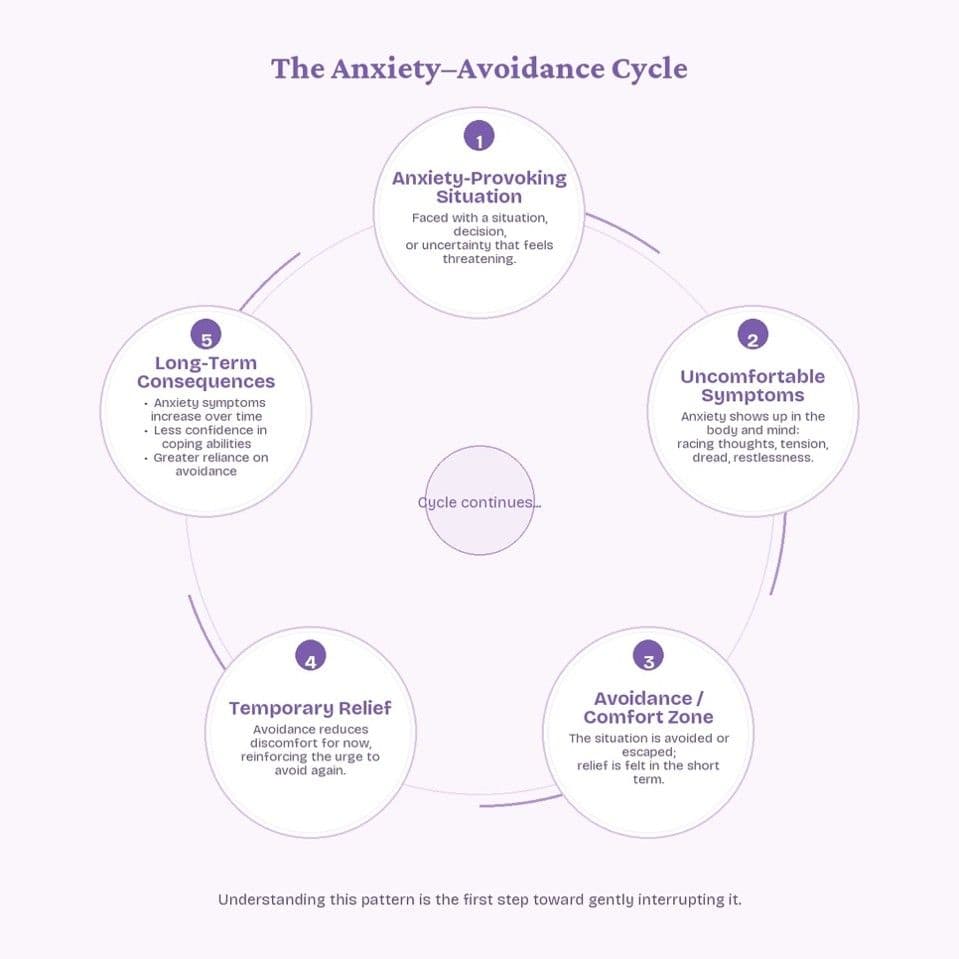
For many of us, this cycle of negative reinforcement has been running for years. I find this heartbreaking because it teaches us to trust perfectionism more than we trust ourselves.
If you recognize this cycle in your own life, I would be glad to explore it with you. You can book a free 20-minute consultation with me to see where you might like to begin.
How Did This Start?
This section is grounded in the narratives we have created about our caregivers and about our own life stories. These narratives can sometimes include imagined or misinterpreted events, but more often than not, they reflect the truth of how we experienced those years.
We can start by saying that perfectionism is a reaction to a lack of trust in, and a deep fear of, the world. This fear often develops from growing up in an environment that had either too many rules or no rules at all. Every human being needs a set of rules to live by in order to feel safe. For example, the laws of nature have taught us that fire burns, so we want to understand our boundaries with it in order to know how to use it safely. The same was true of our worlds when we were children: we looked to our caregivers for guidance on what was safe to do and what was not. Those who grew up with caregivers who had endless rules already have a template of endless rules to live by, rules that are powered by fear in you, just as they were powered by fear in your caregivers. Those who grew up with no rules, or with confusing ones, have had to create their own to find a sense of safety. These rules can sometimes be extreme and unrealistic, as seen in individuals with Obsessive Compulsive Disorder (OCD), but living by unrealistic rules can feel more bearable than living in the unknown.
Two of the main areas in which we strive to create rules are emotions and relationships, since these are among the most uncertain and unclear areas of our lives. With emotions, this could look like cutting ourselves off from our own feelings, hiding them from others, or even avoiding situations that might evoke emotions, as is again seen in some individuals with OCD. In relationships, it might show up as caregivers who fear dependency and want their children to grow up quickly because they cannot tolerate the idea of their children being attached to them and dependent on them.
If you are curious about how these early rules and caregiver relationships continue to shape us, you may find it helpful to explore healing pain by exploring our family of origin.
Does that mean most people with perfectionistic tendencies stay away from relationships completely?
No, they do not! In fact, they would much rather be in relationships, but on their own terms. They usually prefer to be in a relationship so they are not lonely, but they keep their partners at a safe distance: not too lonely, not too vulnerable. This behaviour can be very confusing for their partners.
To learn more about how these patterns of closeness and distance show up between partners, you may also enjoy reading about relationship dynamics through attachment theory.
Likely Symptoms to Experience
In reality, perfectionism is an avoidant structure, which is why procrastination is one of the most common struggles for people with perfectionistic tendencies. Here are some other symptoms you might experience:
- Difficulty starting or completing tasks
- Intolerance for uncertainty
- Anxiety and distress
- Burnout and exhaustion
- Over-preparation
- Self-criticism
- Comparison with others
- Reduced creativity and risk-taking
How Can Narrative Therapy Support You?
You may have noticed that throughout this article, I have used the language of narrative therapy. This therapeutic approach relies heavily on our life narratives, the language we use, and the meanings we make. A core belief in narrative therapy is that ‘you are not the problem; the problem is the problem.’ If you and perfectionism are seen as one and the same, then how can you be cured of perfectionism? How can you be cured of yourself? That is why the first step is recognizing that perfectionism is separate from you, and that you have a relationship with it.
Narrative therapy invites you to look closely at this relationship. When did it start? Do you like it? How is it serving you? What is it taking away from you? How do you want it to change? It is important to highlight that perfectionism will show up as a different companion for each of us, depending on our life stories, our experiences, and the meanings we make of them. That is why revisiting definitions can also be a big part of this therapeutic process. What do achievement, success, or stability mean to you? Do they define your value or self-worth? Where do these definitions come from?
If you would like to look at your own relationship with perfectionism through a narrative lens, I invite you to book a free 20-minute consultation with me so we can start that conversation together.
Some other starting points for healing perfectionistic tendencies include:
- Managing self-criticism and negative self-talk
- Starting (a project, a habit, etc.) regardless of ‘errors’ is one of the most difficult decisions to make, and it is also where much of the healing happens. Over-preparation plays a role here too; each of us can find plenty of reasons to justify our inaction and avoid starting.
- Give yourself permission to do a rubbish job!
- Be open to disappointment so you can start and, eventually, succeed
- Consistency means starting again every day. If you struggle with starting, you will likely struggle with consistency too. This daily struggle to begin is something many people go through, which is why starting is a choice you make every day. Each time you wake up, you get to choose again. This process can often feel daunting, and that is completely normal.
- Learning to tolerate uncertainty
Take a Quiz
If you are curious about where your level of perfectionism might stand, you can take this online quiz from Psychology Today: https://www.psychologytoday.com/us/tests/personality/perfectionism-test
You are welcome to reflect on your results, or even on the thoughts and emotions that come up as you answer the questions. You can do this through journaling or with a professional.
Book Your Free 20-Minute Consultation
If you are hoping to learn more about perfectionism and your own relationship with it, or if you want to manage your symptoms and start living a less stressful life, I invite you to book a free 20-minute consultation with me.
Together, we can explore any questions or concerns you may have and decide whether working together is the right fit for you.
About Salma Faragalla
I am passionate about working with individuals who are in the process of self-discovery, making meaning of the world, and building healthy relationships.
My approach draws from narrative therapy, person-centred therapy, and emotionally focused therapy.
I am registered with the College of Registered Psychotherapists of Ontario (CRPO) as a Registered Psychotherapist (Qualifying), and I hold a Master’s degree in Counselling Psychology from Adler University in Vancouver. I have worked in both agency and private practice settings, which has given me a wide range of experience working with people of different ages, backgrounds, and presenting concerns.
Frequently Asked Questions
Can perfectionism affect your relationships?
- Absolutely. It might show up as wanting to control how your loved ones behave, act, and live their lives, out of fear for them or for yourself. It can also show up as hiding parts of yourself out of fear that you are not good enough to keep your loved ones around. In both cases, it can keep you from truly experiencing the vulnerability and comfort of healthy relationships.
Can therapy help me?
- Of course. Therapy helps with the crucial first step of becoming aware of and understanding yourself and your patterns. It then helps you build new habits, patterns, and ways of living that put you, not fear, in the driver’s seat.
Is online therapy available?
- Yes, online therapy is widely available, and I offer it as well.
If you would like to see whether online sessions feel right for you, I invite you to book a free 20-minute consultation with me.